← Home About Archive Photos Replies Also on Micro.blog
  • Cisco Solitaire

    The history of, and how to play, Cisco, a challenging two-pack solitaire card game otherwise known only as “cabin solitaire.” It’s a patience game passed down through at least five generations of my family.

    Some of my most constant childhood memories are of evenings at my mother’s family’s cabin in Wisconsin’s North Woods. The cabin sits on Cisco Lake, surrounded mostly by birch and other trees suited to the northern climate and poor soil. My great-grandfather built it by hand alongside his two sons-in-law, one of whom was my maternal grandfather. It now belongs to another branch of our family, but it carries for me the accumulated history that places like this do: the old furniture, the smell of wood and smoke, the rituals.

    The rough-finished, high-ceilinged living room was dominated by a large, free-standing stone fireplace and metal chimney hood in its center. Even in the summertime, nights were generally chilly, and there would be a fire every night. Fifty years on, I easily can picture the low amber light and hear the quiet sound of cards methodically being shuffled and slapped on the dining table.

    It was a ritual. Every night after dinner, two or three of the older adults would sit together around the table and in parallel play a very specific solitaire card game. I didn’t have a name for it other than “cabin solitaire”; as far as I know, the game had no other name, at least not one anyone in the family remembers. But I came to know it by heart just from watching, asking my grandfather for rule clarifications when I needed them.

    Superficially, the game resembles Klondike solitaire—the game nearly everyone knows from countless digital versions (the classic Mac shareware remains my favorite). It departs from standard Klondike in ways that make it substantially more complex and more interesting. It uses two decks. It has ten tableau columns instead of seven. And crucially, when you draw from the stock, you don’t choose where the card goes: one card is dealt face-up onto every column in turn, regardless of fit, burying your carefully built sequences under whatever the deck decides to send. The resulting tangles are the game’s central puzzle, and unwinding them—engineering chains of moves to free a buried card before it becomes an unsolvable blockage—is where the real skill lives.
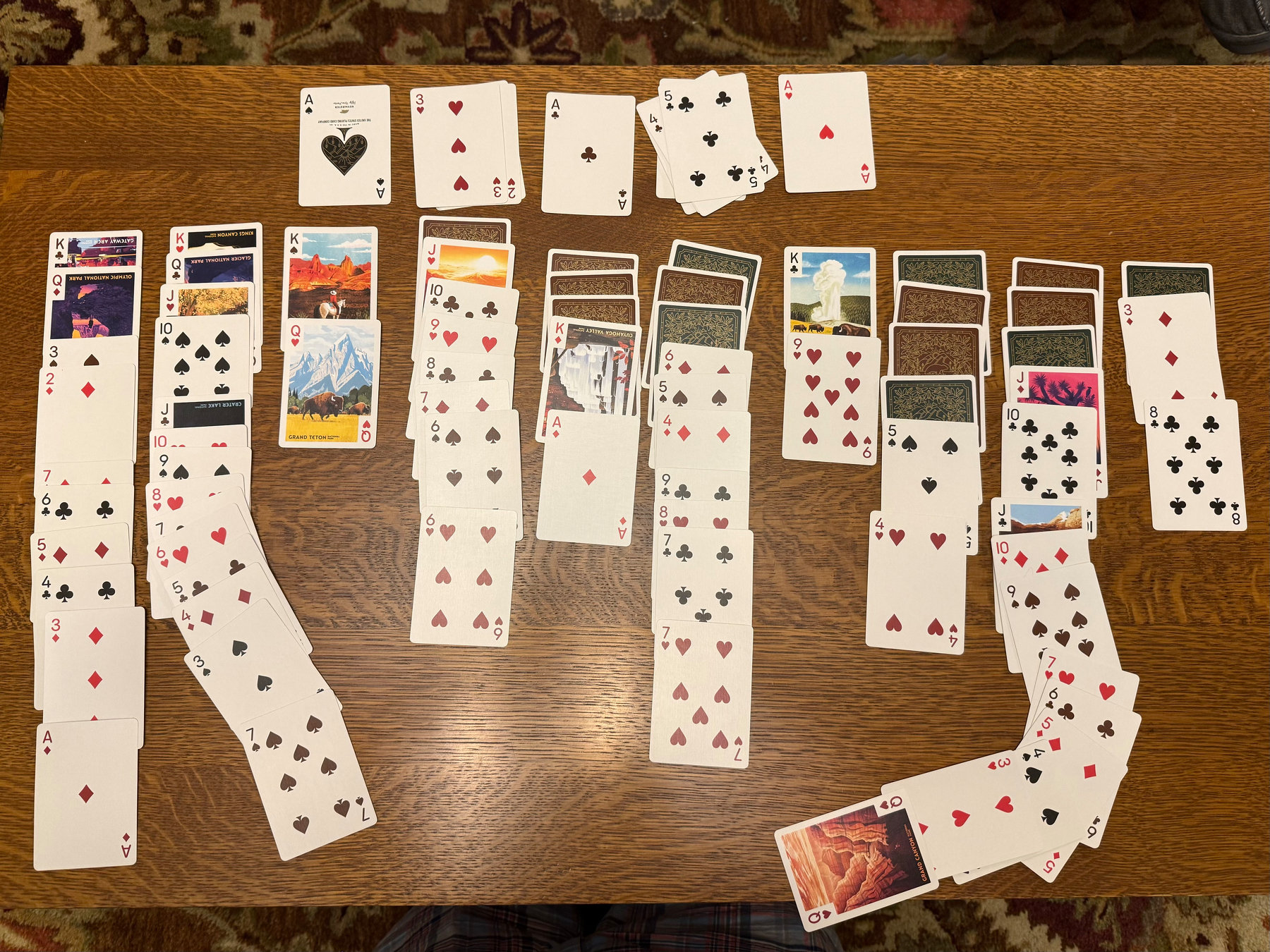
    A game of Cisco solitaire in progress

    I don’t know where my great-grandparents learned the game. From one of their own families? From the close-knit church community in the small town in which they lived? My grandfather said he learned it from them, my grandmother’s family. Whatever its source, that puts its origins in the early twentieth century at the very latest.

    I assumed for years that it must have been described in a Hoyle-style compendium, and that I simply hadn’t come across an official description of our cabin’s solitaire variant. I’ve periodically looked for references to the rules over the past 25 years, but I’ve found nothing. The game appears in none of the major patience collections, not in David Parlett’s definitive histories, not among Pagat’s references, not on Solitaire Central or any of the software libraries I’ve seen that among them document hundreds of games. The specific mechanic that defines my family’s cabin game—the mandatory round-deal, one card to every column, no exceptions—is unusual in the literature.

    So I documented the game myself, with some help from Claude to verify the rules’ logical consistency and alignment with standard solitaire nomenclature. I also chose to give the game a name: Cisco, after the lake. That seems to fit the company of the classics—Klondike, Yukon, Canfield, Cisco—and it will mean something specific to anyone in my family who has spent an evening playing cards at our cabin’s table.

    Cisco Solitaire Rules

    A challenging two-pack solitaire game otherwise known only as “cabin solitaire.” It’s a patience game passed down through at least five generations of my family. Origin unknown, dating to the early 20th century or earlier. Rules documented here for posterity.

    Overview

    Cisco is a single-player patience game played with two standard 52-card decks (104 cards total). It follows the core structure of Klondike—alternating-color descending tableau packing, suit-ascending foundations—but extends to ten tableau columns, uses a double pack with eight foundations, and replaces Klondike’s selective stock draw with a mandatory round-deal mechanic that distributes one card to every column in turn. This deal mechanic is the game’s defining feature: it deposits cards onto tableau columns regardless of their fit, creating tangled, disordered packets that the player must unwind through careful sequencing. The game is substantially more complex and longer than standard Klondike.

    Using two packs with complementary but contrasting back designs is recommended. Stylistically-matched backs are aesthetically pleasing during play, and a contrast simplifies separating the packs after the game.

    Glossary

    I’ve tried to use the definitions typically used in solitaire rulebooks, in particular Parlett’s terminology.

    Pack. A standard 52-card deck (Jokers removed). This game uses two packs shuffled together.

    Stock. The face-down pile of undealt cards set aside after the initial deal. The stock is the source of all subsequent card distributions to the tableau.

    Tableau. The ten columns of cards that form the main playing area. Cards in the tableau are available for packing and transfer to the foundations.

    Column. One of the ten vertical fans of cards in the tableau. Within each column, cards are spread toward the player so that all face-up cards are visible. The exposed card of a column is the outermost face-up card—the one available for play. Face-down cards in a column are not available for play.

    Exposed card. The outermost face-up card of a tableau column. This is the card available for packing onto another column or playing to a foundation.

    Packet. A group of two or more contiguous face-up cards moved together as a unit from one tableau column to another. A packet may contain cards that are not in proper packing sequence with one another.

    Foundations. Eight piles built up in suit and ascending rank from Ace to King. Two foundations are required per suit (one per pack). Foundations are located above the tableau.

    Packing. Placing a card or packet onto a tableau column in descending rank and alternating color.


    Components

    • 2 standard 52-card packs (104 cards total; Jokers removed)
    • A large playing surface—tableau columns grow long during play

    Object

    To move all 104 cards to the eight foundations, each built up in suit from Ace to King.

    Layout

    The game has three areas:

    Foundations. Eight empty piles above the tableau. Each is started with an Ace of its suit and built up in suit to the King. There are two foundations per suit. Foundations may be started in any order as Aces become available.

    Tableau. Ten columns dealt from the combined pack (see Deal below). Columns are fanned toward the player so that all face-up cards are visible. Face-down cards are visible only as to their number and position in the column.

    Stock. The remaining face-down pile after the initial deal, set to one side. There is no waste pile.

    Initial Deal

    Shuffle both packs together thoroughly into a single 104-card pack. Deal the tableau in the staircase pattern of classic Klondike, extended to ten columns. Cards are dealt one at a time, left to right across the columns, repeating from column 1 each time a pass is complete:

    • Column 1 receives 1 card (face up).
    • Column 2 receives 2 cards (1 face down, with 1 face up on top of it).
    • Column 3 receives 3 cards (2 face down, with 1 face up on top).
    • … continuing thus …
    • Column 10 receives 10 cards (9 face down, with 1 face up on top).

    After the deal, 55 cards occupy the tableau and 49 cards remain in the stock. The exposed card of each column is available for play.
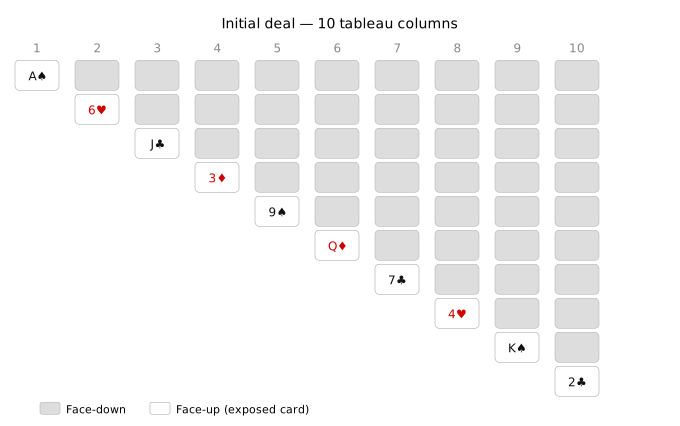
    Figure 1. The initial deal. Column 1 has 1 card (face up); column 10 has 10 cards (9 face down, 1 face up). Each column’s single exposed card is available for play. 55 cards are in the tableau; 49 remain in the stock.

    Play

    Play proceeds continuously; there are no turns per se. The player may make any legal move at any time, in any order, and may deal from the stock at any point (see Dealing from the Stock below).

    Packing

    Any face-up card and its descendants, if any, in a single column may be packed onto the exposed card of another column, provided the card being moved is one rank lower and of opposite color to the destination card. Example: the 7♠ may be packed onto the 8♥ or 8♦. Only face-up cards may be moved, and only the exposed card of another column is available as the destination for packing. Face-down cards are never directly available for play.

    Moving a Packet

    Single exposed cards are not the only cards eligible for movement in the tableau. A packet—any contiguous group of face-up cards taken from the outer end of a column—may be moved as a unit to another column, provided the innermost card of the packet (the card that will make contact with the destination column’s exposed card) is one rank lower and of opposite color to that destination card. This is the same general method of movement in all Klondike- and Yukon-style solitaires. As with Yukon-style games in particular, the remaining cards in the packet need not be in proper packing sequence with one another; they travel with the packet regardless of their internal arrangement. Face-down cards may never be included in a packet.
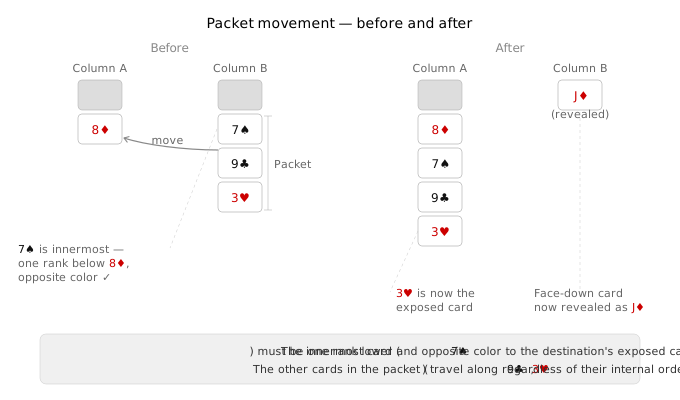
    Figure 2. Packet movement. The packet on Column B (7♠–9♣–3♥) is moved to Column A. The innermost card of the packet, 7♠, makes the legal packing move onto 8♦ (one rank lower, opposite color). The remaining cards, 9♣ and 3♥, are not in packing sequence with each other but travel with the packet regardless. The vacated Column B reveals its previously face-down card.

    Foundations

    A single exposed card of any column may be played to a foundation at any time, provided it is the correct next card in suit and rank for that foundation. Only an Ace may be played to start a new foundation. Once played to a foundation, a card may not be returned to the tableau.

    Vacated Columns

    When all face-up cards have been removed from a column and a face-down card is exposed, that card is turned face up and becomes the new exposed card of the column. When an entire column is vacated—all cards removed—only a King, or a packet whose innermost card is a King, may be moved to fill the space.

    Dealing from the Stock

    The player may choose to deal from the stock at any point during play. Once begun, the deal proceeds as follows without exception:

    1. The deal is mandatory and indiscriminate. One card is dealt face up onto each tableau column in order from column 1 (leftmost) to column 10 (rightmost). The player has no choice about which column receives which card. Each card is placed on the column’s current exposed card, becoming the new exposed card of that column, regardless of whether it constitutes a legal packing move.
    2. The deal cannot be interrupted. Once a deal begins, it must be completed before any further moves in the tableau.
    3. Final deal. When fewer than 10 cards remain in the stock, the deal proceeds left to right until the stock is exhausted. Columns beyond the last card receive none. The player may not skip any column—cards are dealt strictly left to right until the stock is empty.
    4. No redeal. Once the stock is exhausted it is not reshuffled or redealt. All remaining play is from the tableau only.

    Stock Deal Arithmetic

    With 49 cards in stock after the initial deal, the size of subsequent deals does not break evenly. Specifically, the final (fifth) deal contains only nine cards:

    Deal Cards dealt Stock remaining
    1 10 39
    2 10 29
    3 10 19
    4 10 9
    5 (final) 9 (columns 1–9 only) 0

    Winning and Losing

    The game is won when all 104 cards have been played to the eight foundations.

    The game is lost when the stock is exhausted and no legal moves remain in the tableau.

    Strategy Notes

    The stock deal mechanic is what distinguishes this game from other documented Klondike variants. Each deal deposits cards indiscriminately onto every column, frequently burying useful sequences beneath out-of-order cards and creating tangled packets that must be methodically unwound.
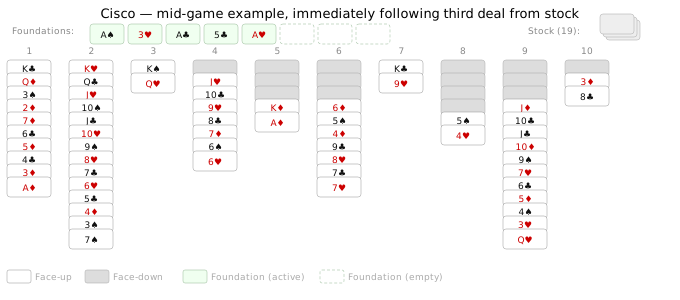
    Figure 3. Mid-game board state after the third deal from stock. Five foundations are active; three remain empty. Several columns illustrate the long, disordered packets that accumulate from repeated stock deals—note the out-of-sequence cards interspersed within otherwise descending runs. Several columns show face-down cards still unrevealed beneath the dealt cards. 19 cards remain in the stock.

    Key strategic considerations:

    • Timing the deal. The player chooses when to deal. Deciding whether to deal now or continue working the tableau first is a meaningful strategic decision at every stage of the game.
    • Column order matters. Because the final partial deal is distributed strictly left to right, what sits atop each column—and which column occupies which position—becomes strategically significant as the stock dwindles.
    • Blocker awareness. Both copies of every card are required to complete the eight foundations. A low card (particularly a 2 or 3) buried deep in a disordered packet can become a game-ending blocker if it cannot be reached. Identifying and freeing potential blockers is a central late-game skill.
    • Vacated columns are precious. An empty column is a powerful resource but can only be filled by a King. Managing when to vacate a column and which King to place there requires foresight.
    • Packet movement is the primary tool. The ability to move any group of face-up cards as a unit—requiring only that the innermost card of the packet makes a legal packing move onto the destination—is what makes unwinding possible. Most of the game’s critical decisions involve engineering a sequence of moves that relocates a marooned packet to expose the cards buried beneath it.

    Relationship to Known Games

    Cisco’s Cousins

    Cisco shares structural features with several documented patience games beyond its superficial similarities to Klondike, but it does not appear to match any of them exactly:

    • Cisco has some elements in common with Rank and File (a Napoleon at St Helena/Forty Thieves variant) in using two packs, ten tableau columns, eight foundations, alternating-color descending packing, and packet movement.
    • It structurally resembles Gargantua (Double Klondike) in its Klondike-style staircase deal, King-only empty column rule, and overall character.
    • The game’s card movement and untangling of unordered sequences are characteristic of Yukon.
    • Cisco’s most significant antecedent may be Miss Milligan, a two-pack patience first documented in print in the early 1900s. Miss Milligan shares with Cisco a core mechanic that defines both games: when the player deals from the stock, one card is distributed face-up onto every tableau column in turn, regardless of fit. However, Miss Milligan also differs in meaningful ways, dealing the initial tableau flat rather than in a Klondike staircase and including a post-stock “waiving” (or “weaving”) grace mechanic not present in Cisco.
    • A Miss Milligan variant called Milligan Yukon—a rather literal cross between Miss Milligan and Yukon—may be the rules closest to Cisco’s. Milligan Yukon appears only in modern software-era catalogs and not in earlier literature, suggesting either a late formalization or an independent convergence.

    Taxonomy and Behavior

    Cisco can be understood as a hybrid of three established patience systems, combined in a unique configuration not clearly documented elsewhere:

    • From Klondike it takes its structure: the staircase deal, alternating-color tableau packing, suit-built foundations, and King-only empty columns.
    • From Yukon it takes its movement model: any face-up packet may be moved as a unit, regardless of internal order.
    • From Miss Milligan it takes its stock mechanic: a deal that distributes one card to every column indiscriminately.

    In most patience taxonomies, movement rules and stock behavior are the dominant modes of classification. That places my game closest to the Milligan-Yukon family of variants that combine Miss Milligan’s row-deal with Yukon-style packet movement.

    Cisco, however, differs structurally in three significant ways from a pure Milligan Yukon game: it uses a ten-column Klondike-style tableau and structural constraints, it omits the reserve and relief mechanisms found in most Milligan variants, and it produces deeper, more entangled positions. It feels very familiar, but plays significantly harder.

    Thus, a shorthand description of Cisco might be:

    Cisco = Klondike framework + Yukon movement + Miss Milligan deal mechanic

    Provenance

    The game has been played in my family for at least five generations: my great-grandparents, grandparents, mother and uncle, myself and my siblings, and now my own children. It originated in the early 20th century or perhaps the late 19th. I do not know its canonical name, if it ever had one.

    These rules were documented April 2026 with the assistance of Claude AI observing my gameplay as I narrated with photographs and then clarified ambiguities through a series of interactive Q&A prompts.

    As I said earlier, I have not found this rule set documented elsewhere. It may well be a heretofore undocumented game. But if I’m wrong, and you know the game, please let me know!

    → 3:07 PM, Apr 5
  • The 182 Words NYT Games Removed from Scrabble for Crossplay

    Note: I list some offensive words in this post.

    I’ve been playing a lot of the new Crossplay Scrabble-style word game from The New York Times, mostly against my sister (and mostly unsuccessfully).

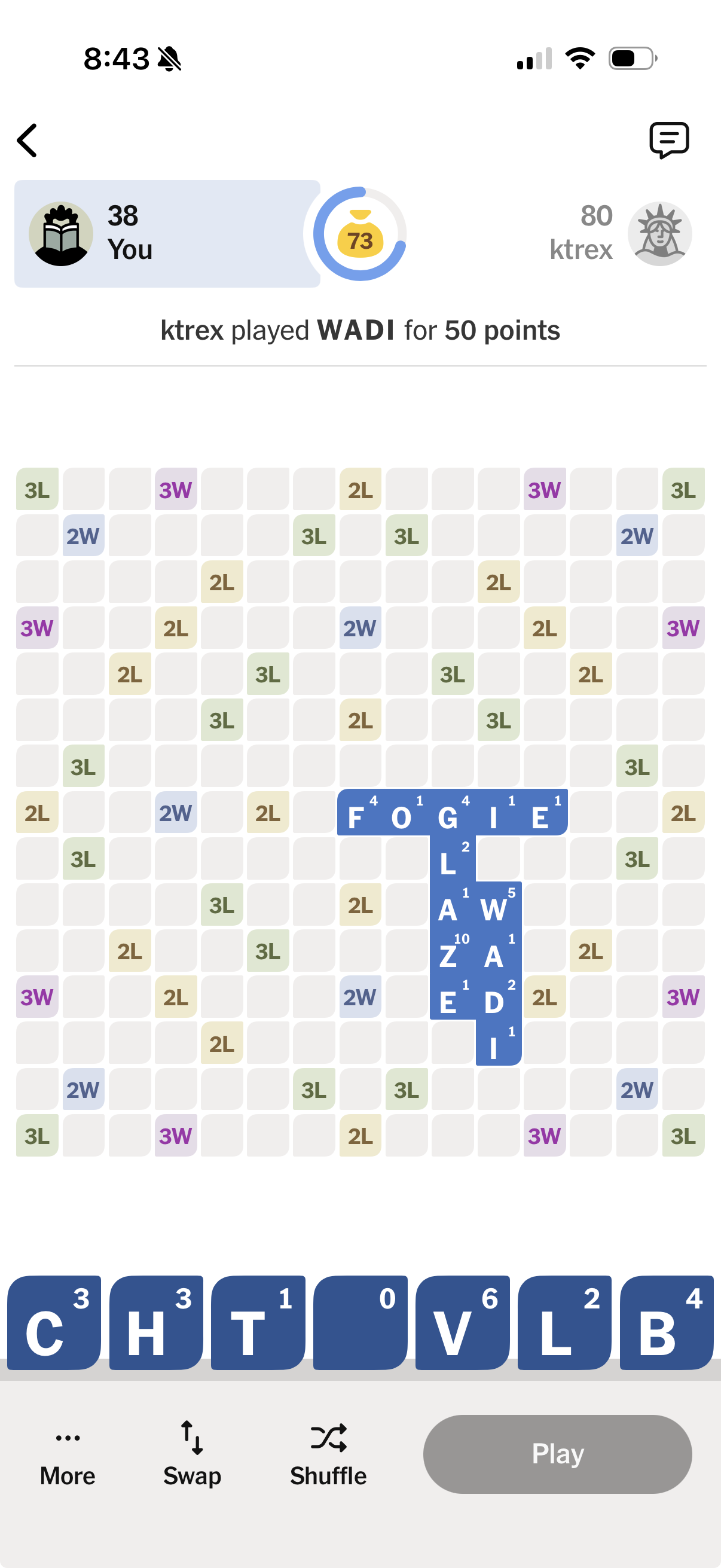
    A screenshot of an NYT Games Crossplay Scrabble-like word game. The board is partially played, with letters forming the connected words FOGIE, GLAZE, WADI, AW, ZA, and ED. The player’s rack contains the letters C, H, T, V, L, B, and a blank tile.

    Unlike Scrabble, Crossplay automatically checks word validity on plays, so the game doesn’t feature bluffing or challenges. That got the word nerd in me wondering about its dictionary and playable word list. I did some sleuthing.

    These Are Not the Dictionaries You’re Looking For

    Before diving into the words allowed in the Crossplay game, understand that the most serious Scrabble players do not use ordinary dictionaries as the authority for playable words.

    Tournament-level Scrabble has a lexicon that is large, obscure, sometimes profane, and the product of occasionally awkward negotiation among the game’s manufacturer, dictionary publishers, and the competitive Scrabble community.

    On the other hand, casual players turn to standard references such as Merriam-Webster or maybe The Official Scrabble Players Dictionary for the especially dedicated. These dictionaries designed for general use don’t specifically list every game-legal word form, and the common abridged editions omit a large number of obscure or controversial, but playable, words.

    Tournament play uses something different: comprehensive, curated word lists derived from dictionaries but authoritative for competitive gameplay. These lists enumerate every legal word form individually, including pluralizations and inflections that ordinary dictionaries treat as grammatical variants rather than separate headwords.

    In the U.S., the primary tournament standard is the NASPA Word List, maintained by the North American Scrabble Players Association (NASPA). The current 2023 edition is commonly referred to as NWL2023.

    In most English-speaking regions other than North America, competitive Scrabble uses a different lexicon known as Collins Scrabble Words (CSW), derived primarily from Collins dictionaries. The Collins lists are larger and somewhat more permissive than the NASPA lists.

    As a result, a word that is legal in one tournament may not be playable in another. Like so many norms, “dictionary authority” in Scrabble is a negotiated concept rather than a simple appeal to Webster or Oxford.

    196,419 Words and Counting

    Casual word games often sanitize their allowable vocabulary. Many ship with word lists that are thousands of words smaller than standard tournament lexicons.

    When it comes to word choices, NYT Games has another very particular layer of consideration. The paper’s games editors express a distinctive voice across its platform: crosswords, Spelling Bee, Wordle, etc. I’d assumed the Crossplay dictionary similarly would show evidence of an opinionated editorial hand: an emphasis on general knowledge, maybe the addition of some NYT jargon or tics, and almost certainly an aversion to working blue.

    So, where to start? The Crossplay app explicitly credits NASPA as a source of its word list. I did some forensics (fancy word, but worth only 14 points in the game) on the Crossplay dictionary and compared it against NWL2023.

    I was surprised to discover that the two lists turn out to be nearly identical. Specifically, the Crossplay word list contains 196,419 entries. NWL2023 contains 196,601. That means the Times removed precisely 182 words from NASPA’s list.

    What do those removed words have in common, and what does the Crossplay database suggest about the game’s design? It’s more interesting than the number of entries alone suggests. Or, at least interesting to a nerd like me.

    Examining the Crossplay Dictionary

    The Crossplay word list is stored internally in a SQLite database inside the app’s software. To look at it, I extracted the file from a copy of the game‘s iOS .ipa bundle saved from my iPhone.

    The table is structured such that each row represents a single playable word and includes a number of associated metadata fields. Exporting the table’s entries produces a dataset with 196,419 rows and 9 columns.

    An excerpt of about a dozen words in the A alpha-sort range illustrates the format:

    word isOffensive isPlayableByComputer definition source partOfSpeech frequency pronunciation register
    aals 0 1 an East Indian shrub 0 0.0
    aardvark 0 1 a nocturnal burrowing… 1 noun 0.05 ˈɑrdˌvɑrk
    aardvarks 0 1 a nocturnal burrowing… 1 noun 0.009 ˈɑrdˌvɑrks
    aardwolf 0 1 a nocturnal black-striped… 1 noun 0.009 ˈɑrdˌwʊlf
    aardwolves 0 1 a nocturnal black-striped… 1 noun 0.008 ˈɑrdˌwʊlvz
    aargh 0 1 used as expression of… 1 interjection 0.001 ɑr(ɡ)
    aarrgh 0 1 aargh 0 0.0
    aarrghh 0 1 aargh 0 0.0
    aas 0 1 rough, cindery lava 0 0.0 ˌeɪˈeɪz
    aasvogel 0 1 a South African vulture 0 0.0
    aasvogels 0 1 a South African vulture 0 0.0
    ab 0 1 the abdominal muscles 1 noun 1.646 æb
    ars 0 1 the letter R 0 0.0
    arse 1 0 an offensive word 0 0.0 vulgar

    (Note: I trimmed content in the definition field for the sake of space.)

    The first word field is the essential one. It defines the playable vocabulary. Matching this column with the NWL2023 headword list allows a direct comparison of the two lexicons. It’s just math:

    • NWL2023 entries: 196,601
    • Crossplay entries: 196,419
    • Difference: 182

    Given the number of words we’re talking about, a difference of 182 entries is remarkably small—less than one tenth of one percent. Crossplay’s word list is almost exactly the same as the one used in North American tournament Scrabble.

    What the Crossplay-Brand Word Game Removed

    A list of 182 words is pretty easy to scan, and a cursory glance showed that nearly every one of the removed words is derived from a trademark, brand, or proprietary product name.

    Examples include:

    • BENADRYL
    • CINEPLEX
    • CUISINART
    • FORMICA
    • JACUZZI
    • KLEENEX
    • ROLLERBLADE
    • TASER
    • VELCRO

    Entire inflectional families disappear together. For instance:

    • BREATHALYZER
    • BREATHALYZE
    • BREATHALYZED
    • BREATHALYZES
    • BREATHALYZING

    Some of the removed words are widely regarded as genericized trademarks, meaning the original brand name has long since entered common usage. Examples include:

    • FRISBEE
    • KLEENEX
    • LAUNDROMAT

    The decision to remove brand names in general makes sense in the context of a commercial software product. Tournament Scrabble lists include these words because they appear in published dictionaries, but a game developer might reasonably prefer to avoid trademark complications entirely.

    However, if the issue were potential legal liability for trademark misuse, expired and other legacy brand terms should not have been a cause for concern. Their removal suggests an automated filtering rule applied to the source dataset, rather than a specific deliberate judgment by NYT Games editors. If the underlying lexical database flagged an entry as trademark-derived, an automated filter would remove it regardless of whether the word has become generic in practice.

    Three Black Sheep

    A very small handful of (and by small, I mean exactly three) removed words do not obviously derive from trademarks. The words are:

    • ADRENALIN
    • ADRENALINS
    • ASBESTINE

    These are simple spelling variants (ADRENALIN for ADRENALINE) and the adjectival form of ASBESTOS. I have no explanation for why these and no other brand-neutral obscurities were removed from the NWL2023 source.

    Talk Dirty to Me

    The more surprising thing to me was what the Times did not change.

    Aside from the trademark filter, the Crossplay lexicon tracks NWL2023 almost perfectly. That includes vocabulary many players might expect the Gray Lady to avoid.

    For example:

    • ASSHOLE
    • COCKBLOCK
    • FUCK
    • MILF
    • TITTIES

    All remain valid words in Crossplay.

    Before examining the data I had assumed that the dictionary might be somewhat bowdlerized to better suit a family newspaper. Instead, Crossplay adopted the tournament lexicon almost wholesale.

    For competitive Scrabble players (along with snickering middle-schoolers and just plain grown-ups who use grown-up words) this is good news. It means the game’s vocabulary basically matches the one used in sanctioned play.

    Slurs Not Welcome

    You might notice that certain offensive words are absent entirely. Those removals did not originate with Crossplay.

    In 2020, NASPA removed about 200 slurs targeting specific categories of personal identity from the allowed tournament list. This decision was somewhat controversial in the community (with the predictable sort of opposition), but it was the right one. NASPA eventually codified the criteria for removal in an official policy. Those changes were incorporated into subsequent lexicon releases, including NWL2023.

    In a weird coincidence, the number of slurs removed from NWL (182) exactly matches the number of additional words removed from the Crossplay dictionary. Counterintuitively, this is pure coincidence; the Times’ list is unrelated to word offensiveness, and the two lists of struck words have nothing in common other than count.

    NASPA did not completely ban offensive words. As I noted earlier, words inappropriate for polite company but not directed at identity groups largely remain in the lexicon. Moreover, words that have established, non-slur meanings in standard dictionaries also were retained.

    Examples of the latter include uncomfortable words like:

    • BITCH
    • CRACKER
    • DYKE
    • FAGGOT

    The NWL list continues to include these because dictionaries document the neutral sense (dog, snack, levee, bundle of sticks, etc.).

    By contrast, the Collins lexicon used in Commonwealth countries has not adopted the same broad removal of slurs, meaning that many offensive words absent from NWL still appear in CSW.

    Crossplay’s NWL and Oxford Languages Sources

    Unlike most Scrabble word lists, the Crossplay dictionary is more than a list of playable words. Each entry includes substantial linguistic metadata.

    Fields include:

    • Part of speech
    • Pronunciation in IPA
    • Usage labels
    • Corpus frequency values
    • Flags controlling AI behavior

    These fields show how the dictionary was assembled from more than one source. We’ve established that every playable word originates from NWL2023, but acknowledgements in the Crossplay app indicate that most of the definitions and linguistic annotations in the data come from Oxford Languages, the dictionary data division of Oxford University Press.

    Deducing meaning from the source field in the database:

    • source = 1 → Definition and metadata are Oxford-sourced
    • source = 0 → Definition is NASPA-sourced

    Out of the 196,419 entries in the database:

    • Oxford definitions: 195,371
    • NASPA definitions: 1,048

    Oxford and other standard dictionaries typically list only a base lemma and describe inflected forms grammatically rather than creating separate entries for each spelling. Scrabble lists, by contrast, enumerate every playable word individually.

    The 1,048 NASPA entries contain only a brief definition and no other metadata — and for many examples, that definition is simply, “An offensive word.” These 1,048 correspond largely to forms that Oxford does not treat as independent headwords. They are Scrabble-style variants that include technical words, offensive language, non-standard inflections, alternative spellings, or verbalisms.

    How the Dictionary Data Appears in the Game

    These source-and-register distinctions are visible in the Crossplay interface itself.

    When a word’s entry comes from Oxford, the in-game dictionary shows a full lexical entry: definition, part of speech, pronunciation, and usage labels.

    When the entry is sourced from NWL instead, the interface explicitly indicates that the definition, if even present, derives from the NASPA word list.

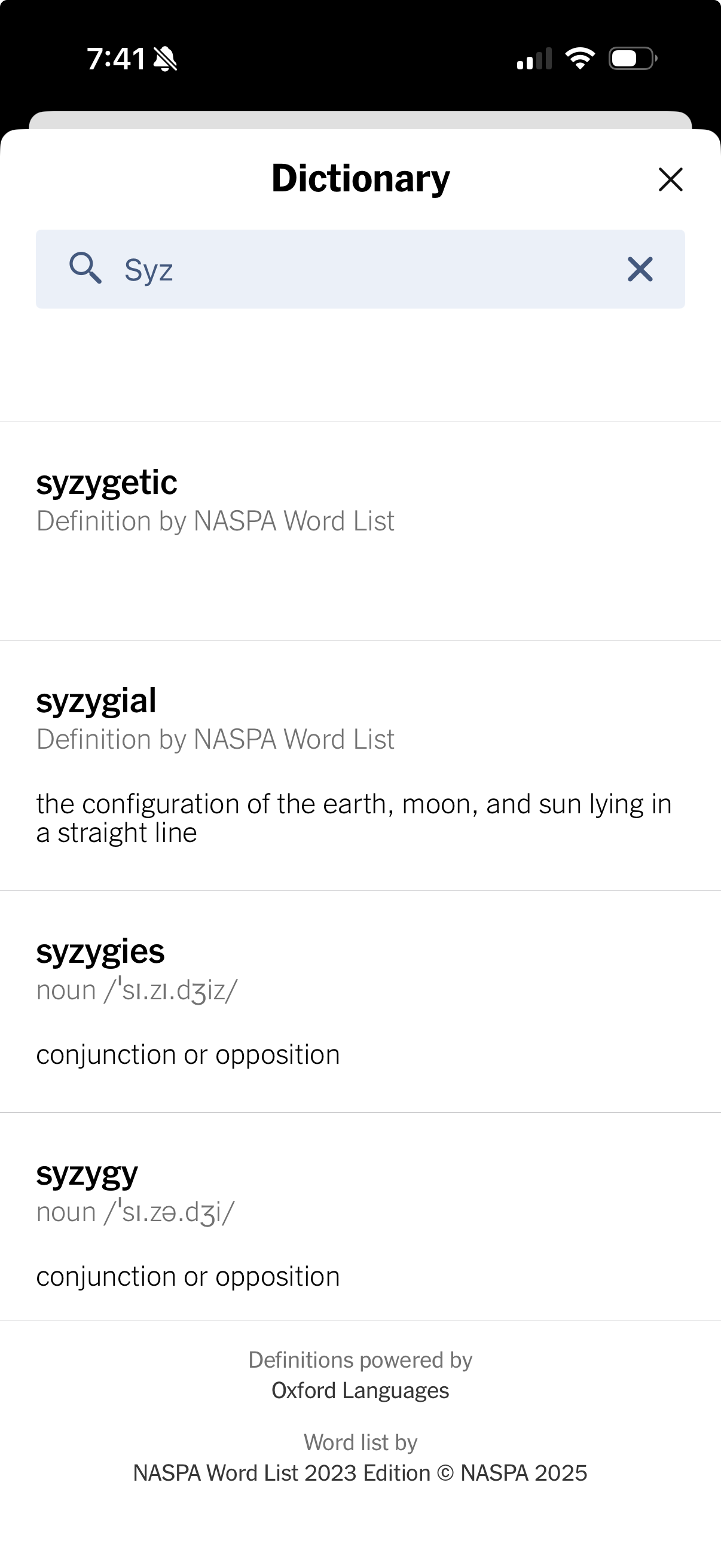
    Screenshot of a smart phone dictionary app displaying definitions for words like syzygetic and syzygy.

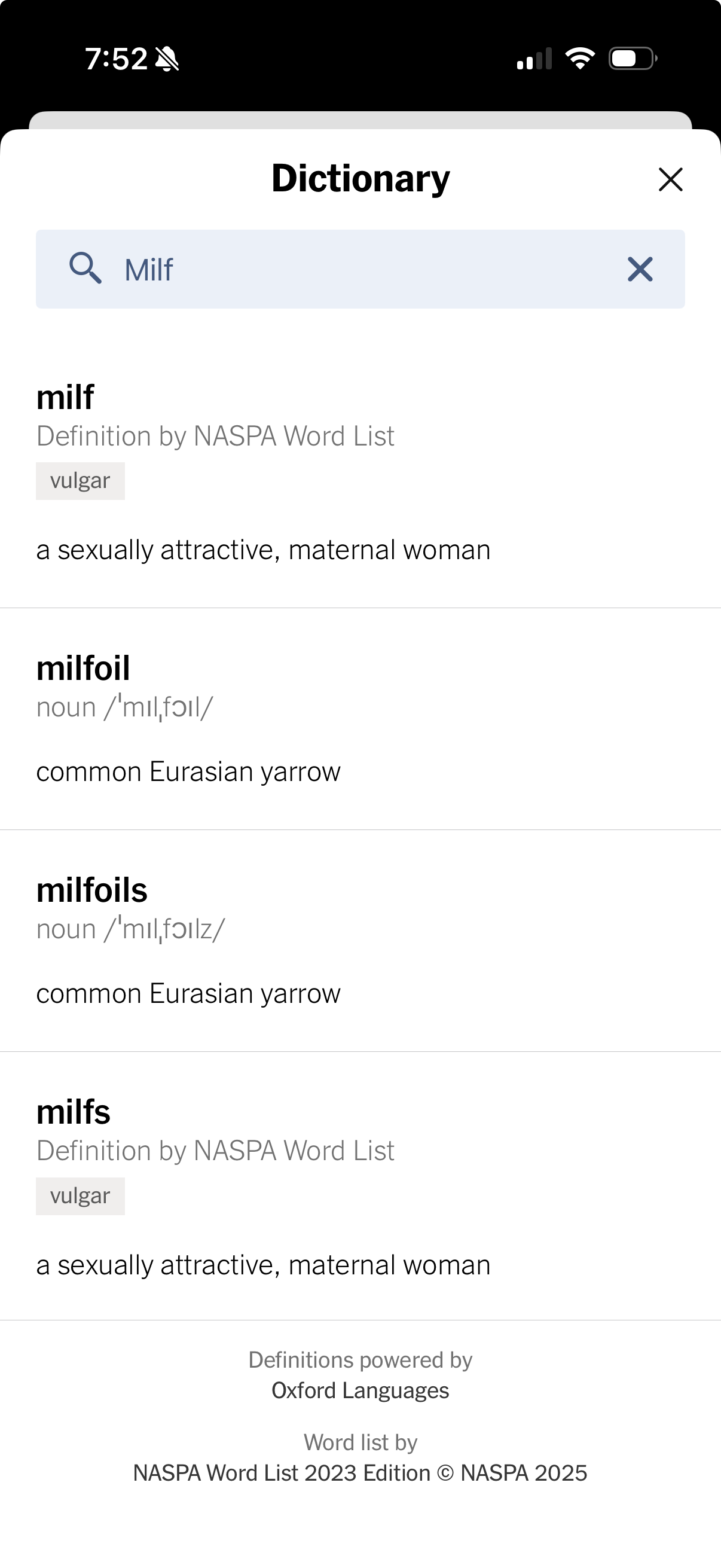
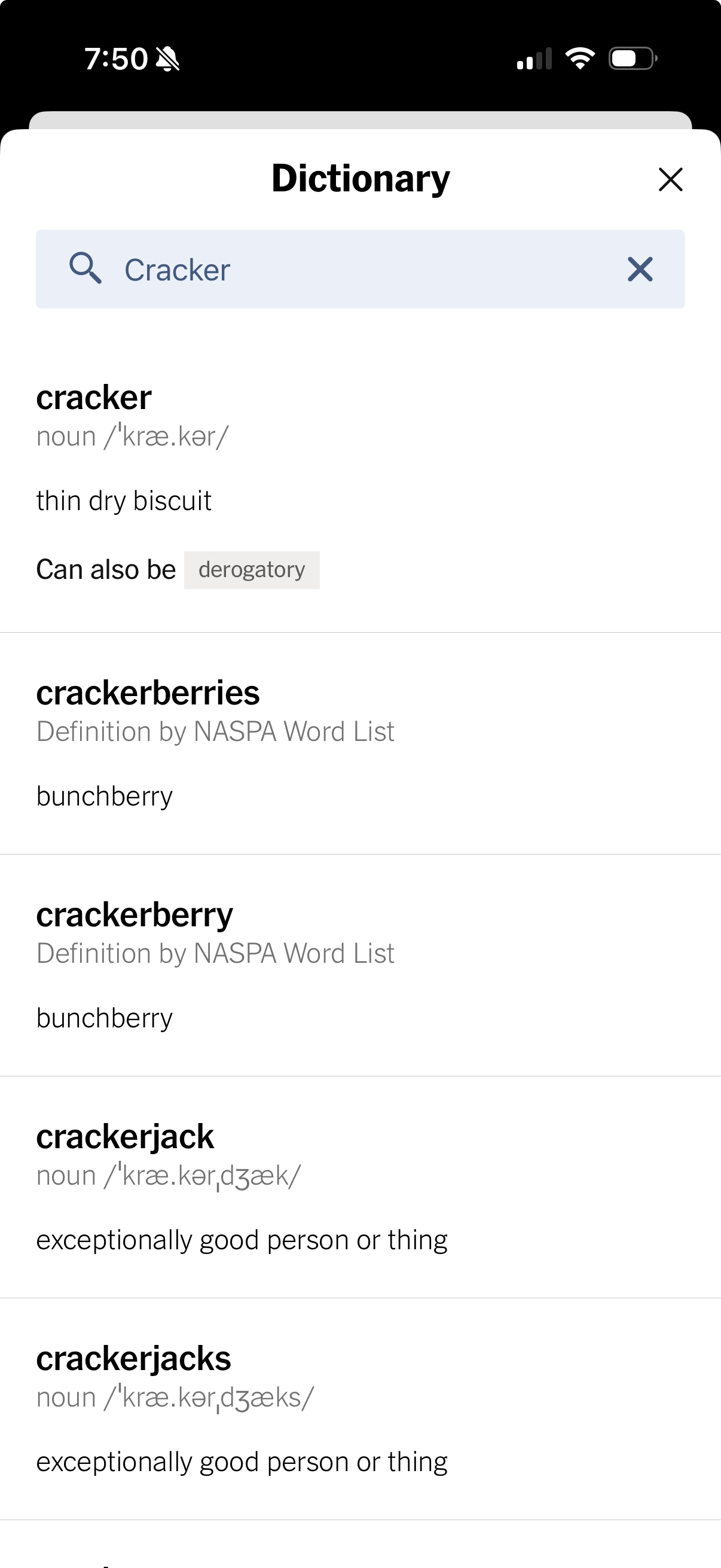
    Labels such as vulgar or derogatory also are visible in the app’s dictionary UI and correspond directly to the register column in the database.

    Screenshot of a smart phone dictionary app displaying definitions for the words milf, milfoil, and milfoils, including a vulgar definition of milf. Screenshot of a smart phone dictionary app displaying the definition of cracker as thin dry biscuit, noting it can be derogatory, and includes entries like crackerberries and crackerjack.

    Scrabbling for 15 Letters

    Another column in the database contains a numeric frequency score that appears to be derived from the Oxford English Corpus, a large database of published English texts. Analyzing this column emphasizes the stark difference between everyday vocabulary and the Scrabble lexicon.

    length average corpus frequency occurrences in Crossplay
    2 extremely high 107
    5 moderate 9463
    10 very low 25002
    15 near zero 3839

    In the real world, the average corpus frequency declines sharply as words grow longer. That’s not the case with the contents of Crossplay’s dictionary.

    Scrabble words are a specialized vocabulary optimized for combinatorial play, not a natural language. The disproportionate number of 10- or 15-letter words in the game dictionary reflects the peculiar composition of these word lists, which include thousands of rare technical terms from fields such as botany, chemistry, and taxonomy that maximize utilization of the game’s 15×15 grid. Words like PSITTACINE (relating to parrots) or ZYZZYVA (a genus of weevils) are perfectly legal Scrabble plays but appear almost never in ordinary English writing.

    Words Available to Crossplay’s Computer Opponent

    The database includes two flags we can conclude govern in-game behavior:

    • isOffensive
    • isPlayableByComputer

    1,049 words are marked isOffensive = 1 (true), and 1,413 words are labeled isPlayableByComputer = 0 (false). Examining the two lists shows that every word marked offensive is unplayable by the computer, but not every word marked unplayable is also considered offensive. To be precise, the offensive words are a strict subset that is 364 entries smaller than the total unplayable words. In mathy terms:

    {isOffensive = 1} ⊊ {isPlayableByComputer = 0}

    The overlap of the two sets reveals several categories of words the computer player can’t use.

    First, the AI won’t play words flagged as offensive or derogatory.

    Second, it skips certain socially sensitive topics. For example, the Crossplay dictionary includes several abortion-related terms that are legally playable but flagged as unavailable to the computer player.

    Finally, the obscurity of the remaining unplayable words suggests the AI avoids vocabulary that would feel implausible to casual players.

    In short, the computer player seems to filter for:

    • No offensive language
    • No social hot-button topics
    • No obtusely uncommon words

    There may be additional rules coded in the software, but the in-game behavior I observed generally matches the signals contained in the word database.

    None of these constraints apply to human players. You and I are free to use the full lexicon represented in the Crossplay dictionary.

    Crossplay Uses a Faithful Scrabble Dictionary

    Taken together, the evidence shows that Crossplay’s vocabulary is essentially NWL2023 minus 179 trademark-derived words and three additional randos. Everything else—from obscure botanical Latin to crude profanity—remains intact.

    Having said that, the Crossplay dictionary itself turns out to be an interesting window into how the game works.

    • The NASPA Word List provides the authoritative list of playable words.
    • Oxford Languages supplies definitions, pronunciations, and corpus statistics.
    • The Times removed trademark-derived vocabulary.
    • Additional metadata guides the behavior of the computer opponent.

    For a casual word game published by The New York Times, that is a surprisingly faithful implementation of the competitive Scrabble lexicon. The result is a dictionary that preserves the full eccentricity of the tournament Scrabble vocabulary while still allowing the game’s AI to behave in a way that feels reasonable to ordinary players.

    P.S. I made a list of all 182 words removed from NWL2023 for Crossplay for easy download.

    → 3:57 PM, Mar 11
  • RSS
  • JSON Feed
  • Micro.blog